
If there’s one maintenance practice that consistently sparks conversation among golfers, it’s aeration. But for superintendents, aeration isn’t a disruption—it’s a critical tool for managing soil health, turf performance, and long-term playability.
Two of the most widely used methods, hollow core aeration and solid tine aeration, serve distinct roles within a comprehensive turf management program. Understanding how and when to use each is key to maintaining high-performing surfaces throughout the season.
Why Aeration Still Matters
Over time, soil compaction is inevitable. Traffic from play and equipment, combined with natural settling, reduces pore space in the soil profile. As compaction increases, oxygen exchange declines, water infiltration slows, and root development becomes restricted.
Aeration addresses these challenges by reopening the soil profile—creating pathways for air, water, and nutrients to move freely. The result is stronger root systems, improved drainage, and more resilient turf.
Hollow Core Aeration: Resetting the Profile
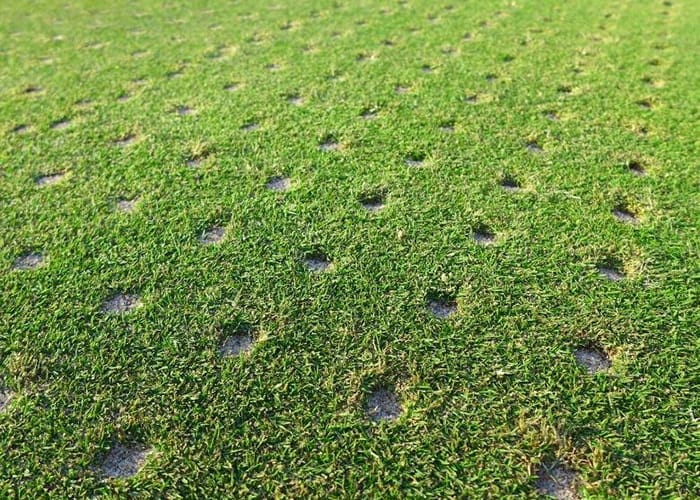
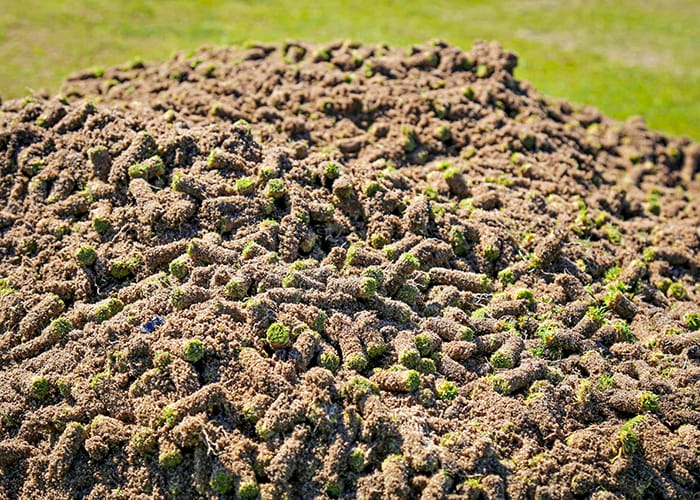
Hollow core aeration remains the most effective method for addressing deeper structural issues in the soil.
By physically removing cores, this practice:
- Relieves deep compaction
- Reduces organic matter accumulation
- Improves soil structure and gas exchange
- Enhances topdressing integration
- Promotes deeper, more vigorous rooting
The Tradeoff:
There’s no avoiding the temporary disruption. Surface smoothness and ball roll are impacted during recovery, and healing can take days to weeks, depending on conditions.
Best Fit:
Hollow core aeration is typically reserved for spring and fall windows, when growing conditions support recovery and superintendents can prioritize long-term gains over short-term playability.
Solid Tine Aeration: Maintaining Performance
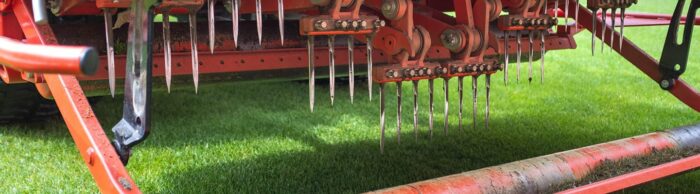
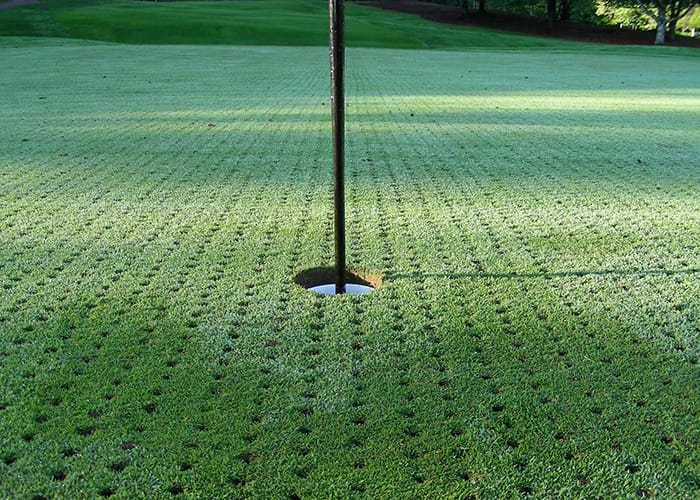
Solid tine aeration, often referred to as venting, plays a different role. Rather than removing soil, it creates channels within the existing profile.
This approach:
- Improves surface gas exchange and water movement
- Relieves light to moderate compaction
- Supports root respiration during stress periods
- Allows for frequent, in-season applications
The Advantage:
Minimal disruption. Surfaces often recover within hours to a day, allowing playability to remain largely intact.
The Limitation:
Because no material is removed, it does little to reduce organic matter or correct deeper compaction challenges.
Side-by-Side Comparison
Hollow Core Aeration vs. Solid Tine Aeration:
- Soil removal: Yes vs No
- Compaction relief: Deep vs Light
- Organic matter reduction: High vs Minimal
- Surface disruption: High vs Low
- Recovery time: Slow vs Fast
- Frequency: 1–2x/year vs Multiple times/year
When to Use Each: A Superintendent’s Framework
Use Hollow Core Aeration When:
- Organic matter is accumulating beyond target levels
- Soil structure needs correction
- Preparing for seasonal transitions
- Maximizing topdressing incorporation
Use Solid Tine Aeration When:
- Maintaining gas exchange during stress
- Managing surface firmness and infiltration
- Minimizing disruption ahead of events
- Supporting light interseeding
Where Interseeding Fits In
Aeration and interseeding often work together.
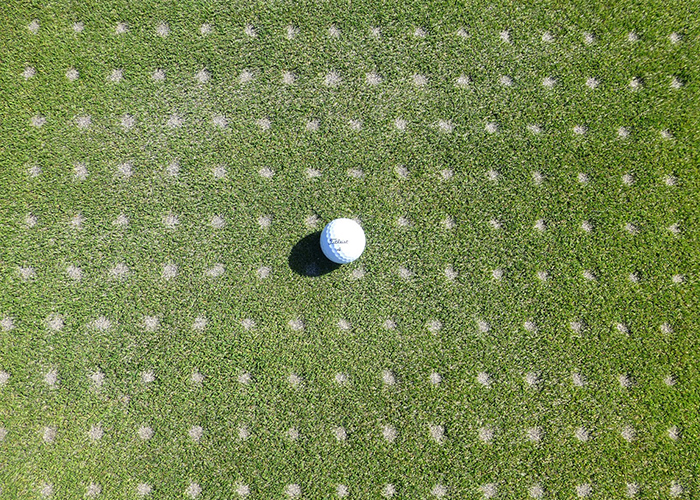
Hollow core aeration supports aggressive seed incorporation during renovation windows, while solid tine aeration enables lighter, in-season interseeding with minimal disruption.
Recovery speed and establishment success are influenced by turf genetics, including varieties selected for establishment rate and stress tolerance.
The Bigger Picture: Performance Over Time
The most successful programs balance both practices.
- Hollow core aeration provides the reset
- Solid tine aeration maintains continuity
Together, they support both playability and long-term turf health.
Final Thoughts
Aeration is one of the most visible practices in golf course management—but its greatest impact happens below the surface.
A well-executed aeration program improves rooting, recovery, and overall surface consistency throughout the season.
Let’s Talk Turf Performance
If you’re evaluating how aeration, interseeding, and cultivar selection work together, connect with Tee-2-Green to discuss strategies tailored to your course.