
Aerification recovery is decided before the first core is pulled.
Golfers see holes, sand, disruption, and temporarily slower greens. Superintendents see an opportunity to relieve compaction, improve gas exchange, increase water infiltration, manage organic matter, create space for new roots, and prepare the turf for the stresses ahead.
Choosing the right tine size, spacing, depth, and topdressing material matters. But the condition of the turf going into aerification, and the way it is managed immediately afterward, determines how quickly and effectively the putting surface recovers.
The best aerification programs begin several days before the first core is pulled and continue well after the final grain of topdressing sand has been worked into the canopy.
Quick Takeaways
- Don’t let the plant go into cultivation hungry. A modest application of 0.25–0.50 lb. of readily available N per 1,000 sq. ft. a few days out gives the turf the energy to start closing holes right away.
- Target uniform moisture, not saturation. A dry profile cultivates poorly and stresses the plant. A wet one smears, ruts, and gives up cores badly.
- Open channels are the best seed-to-soil contact you’ll get all season. Interseed after core cleanup and before final topdressing to get seed into the soil instead of stuck in the canopy.
- Judge recovery below the surface. Rooting, infiltration, firmness, and seedling establishment tell you more than how fast the holes disappeared.
Pre-Aerification: Prepare the Plant Before You Stress It
Aerification provides tremendous long-term benefits, but the process temporarily stresses the plant. Roots are severed. Leaf tissue can be damaged. The soil profile is disturbed. Topdressing creates additional abrasion, and mowing and rolling practices may need to change during recovery.
The objective before aerification should be simple:
Go into the process with actively growing, properly hydrated turf that has adequate nutritional reserves to begin recovering immediately.
Nitrogen: Build the Recovery Engine
A modest nitrogen application three to seven days before aerification can stimulate growth and prepare the turf for rapid recovery. Depending on turf conditions, season, soil temperature, fertility history, and the severity of the upcoming cultivation, approximately 0.25–0.50 lb. of readily available nitrogen per 1,000 sq. ft. may be appropriate.
The goal is not excessive growth. It is to make sure the plant isn’t entering a major cultivation event hungry. Actively growing turf is better positioned to produce new leaf and root tissue and close aerification holes quickly.
Hydrate the Root Zone
Moisture management before aerification is just as important as fertility. A dry, hard profile makes cultivation more difficult and increases stress on the turf. Excessively wet soil creates its own problems, including smearing, rutting, poor core removal, and unnecessary surface damage.
Ideally, the root zone should have uniform moisture without being saturated. A deeper irrigation one or two days before cultivation may be appropriate depending on soil conditions, weather, drainage, and the aerification method being used. The target is a soil profile that cultivates cleanly while maintaining adequate moisture around the existing root system.
Consider Pre-Stress Conditioning
Many superintendents incorporate biostimulants, carbon-based products, seaweed extracts, humic materials, amino acids, or other specialty amendments before aerification. These products should complement sound fertility and irrigation practices, not replace them.
A targeted application approximately two to three days before aerification can fit well into an established program, particularly when the turf is entering cultivation following periods of summer stress. Think of this period as preparing the plant’s recovery system before the injury occurs.
Aerification Day: Protect the Opportunity You Just Created
Once cores are pulled or cultivation holes are created, the superintendent has something extremely valuable: direct pathways into the root zone. Those channels allow oxygen, water, nutrients, and amendments to move deeper into the soil profile, which makes the hours immediately following cultivation an important management window.
Remove Cores and Debris Efficiently
When hollow-tine aerification is performed, cores should be removed as efficiently as practical to minimize additional traffic and mechanical damage. Once cleanup is complete, the next steps can begin as conditions allow.
Prepare the Holes for Topdressing and Seed
The objective of topdressing isn’t simply to cover the putting surface with sand. The sand should move down into the aerification channels. Properly filled holes help maintain surface stability, improve soil physical properties, dilute organic matter, increase infiltration, maintain pore space, and create a better environment for future rooting.
When interseeding is part of the program, aerification provides another opportunity before the final topdressing and brushing operations are completed.
Post-Aerification Interseeding: While You’re at It, Add Seed
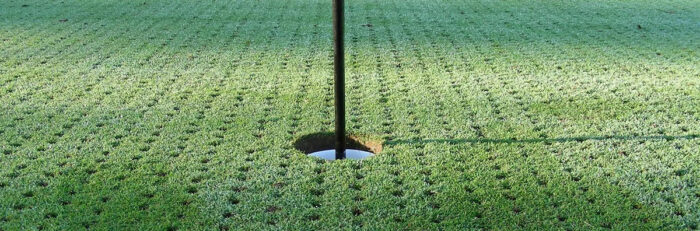
Immediately following aerification, thousands of openings are available across the putting surface. These channels improve seed-to-soil contact and give new seedlings protected places to establish within the existing turf canopy.
For superintendents looking to increase bentgrass density, repair thin or damaged areas, or gradually introduce improved genetics into an existing green, this is an ideal time to interseed with Tee-2-Green creeping bentgrass.
Seed After Aerification
Once cores and debris have been removed, apply the selected Tee-2-Green bentgrass cultivar or blend. Depending on the program and equipment available, seed can be drop-seeded into the open holes or introduced through slit or slice seeding to maximize seed placement and seed-to-soil contact. Typical interseeding rates run 0.5–1.0 lb. per 1,000 sq. ft., depending on recovery goals and turf conditions.
Distribute the seed uniformly and place as much viable seed as possible into contact with the soil and aerification openings rather than leaving it suspended in the existing canopy.
When appropriate, apply seed before the final topdressing and brushing operations. The topdressing process then helps move seed into the openings and creates the seed-to-soil contact needed for germination.
Why Interseed During Aerification?
Interseeding during aerification takes advantage of conditions that are difficult to reproduce during normal putting-green management. The canopy has been opened, competition immediately around the holes has been temporarily reduced, and seed has a far better chance of reaching the soil.
That creates an opportunity to increase creeping bentgrass density, fill thin or damaged areas, introduce improved Tee-2-Green bentgrass genetics, and improve putting-surface uniformity, all while the green is already being managed aggressively for recovery.
Topdress and Work the Seed Into the Surface
Following seeding, apply the planned topdressing and carefully work the sand into the aerification holes. The goal is not to bury the seed excessively. Use the aerification channels, brushing, topdressing, and irrigation together to create good seed-to-soil contact while keeping conditions favorable for germination.
Several light brushing or dragging passes are often more effective, and less disruptive, than trying to force all of the sand into the holes at once.
Manage Moisture for Germination
Newly seeded bentgrass requires a different moisture strategy than an established putting green. The immediate goal is to keep the seed zone consistently moist without saturating the root zone.
Light, frequent irrigation may be necessary during germination, particularly in warm, sunny, windy, or low-humidity conditions. As seedlings emerge and begin developing roots, irrigation frequency can gradually be reduced to encourage deeper rooting.
Keep the existing turf healthy while maintaining enough surface moisture to establish the new Tee-2-Green bentgrass seedlings.
Post-Aerification Fertility: Feed Recovery Without Overdoing It
The existing plant is trying to repair damaged tissue while producing new roots and shoots. If interseeding was performed, new seedlings are also beginning to establish. Both require energy, which makes nutrient availability especially important in the first several days.
Carbon-Based and Organic Nutrition
Carbon-based fertilizers and organic nutrient sources can be incorporated as part of the recovery program. Open aerification channels provide an opportunity to move certain materials farther into the upper root zone than would normally occur through a closed canopy.
The objective remains balanced nutrition and support of the soil environment, not applying more product simply because holes are present.
Foliar N-P-K and Micronutrients
A light liquid fertility application following aerification provides readily available nutrition to support recovery. A complete foliar program may include nitrogen, potassium, phosphorus where appropriate, micronutrients, and supplemental biological or biostimulant components.
Products such as Foliar-Pak Grow-In or comparable recovery-oriented fertility programs can be incorporated where they fit the superintendent’s existing fertility strategy.
The target is not excessive top growth. It is controlled, consistent growth that steadily rebuilds the putting surface.
Irrigation: One of the Biggest Factors in Recovery
Fertility receives plenty of attention following aerification, but moisture management can ultimately determine how quickly the turf responds and, when interseeding, how successfully new seed establishes.
Water After Topdressing and Fertility
Following seeding, topdressing, and fertilizer applications, irrigation settles the sand, washes material off leaf tissue, moves soluble nutrients into the upper soil profile, and provides the moisture needed to start germination. It also begins stabilizing the newly disturbed root zone.
Don’t Let the Surface Dry Out
Aerification changes the way the upper soil profile interacts with the atmosphere. Open holes increase gas exchange, which is one of the primary reasons we aerify, but they also increase drying.
Roots exposed along aerification channels can quickly experience moisture stress, while newly planted bentgrass seed needs consistent moisture to germinate. During the first several days, monitor soil moisture closely and maintain consistent moisture without keeping the profile saturated. Frequent observation and moisture-meter readings are especially valuable during this period.
Days 3–7: Shift From Recovery to Growth
Once the immediate stress of aerification has passed, management can gradually move back toward normal. This is when a second nutritional application may be beneficial.
Granular Follow-Up
Approximately one week after aerification, a light granular N-P-K application may be appropriate depending on turf response, soil conditions, temperature, previous fertility, and the establishment of any newly seeded bentgrass. This provides sustained nutrition as the turf continues filling holes and rebuilding density.
The exact fertilizer and rate should come from the superintendent’s fertility program, not a universal calendar recommendation.
Watch the plant. If recovery is already aggressive, additional nitrogen may not be necessary. If growth is slow because of inadequate fertility, cool temperatures, root stress, or other factors, additional nutrition may help.
Leaf Area First, Green Speed Second
Leaf area is the plant’s recovery engine. Every additional day of healthy leaf tissue contributes energy toward closing holes, rebuilding roots, and, when interseeding, establishing new seedlings. Aggressive mowing, low mowing heights, excessive rolling, and repeated mechanical traffic all cut into that energy, and new bentgrass seedlings are especially vulnerable.
Immediately following aerification, consider temporarily raising mowing height, using solid rollers where appropriate, minimizing unnecessary traffic, keeping mower blades extremely sharp, avoiding aggressive grooming, and allowing the plant to rebuild adequate leaf area.
Once the canopy begins closing and the surface stabilizes, mowing height and rolling frequency can gradually return to normal.
The 7-Day Aerification Recovery Window
A practical program might look something like this:
7–5 Days Before
Evaluate plant health, root depth, weather, soil temperature, and moisture conditions. Begin preparing the turf nutritionally.
5–3 Days Before
Apply approximately 0.25–0.50 lb. N/1,000 sq. ft. when appropriate. Apply planned biostimulants or specialty amendments.
2–1 Days Before
Bring the root zone to appropriate moisture levels. Avoid entering aerification with either excessively dry or saturated soil.
Aerification Day
Aerify and remove cores and debris. Prepare the open aerification channels for seed and topdressing.
Immediately After: Interseed
Apply the selected Tee-2-Green creeping bentgrass cultivar or blend, concentrating on uniform distribution and maximum seed-to-soil contact. Follow with topdressing and work the sand and seed carefully into the openings.
Days 1–3
Maintain consistent moisture for both turf recovery and seed germination. Reduce mechanical stress and monitor the putting surface closely.
Days 3–5
Continue light nutrition as needed. Monitor seedling emergence and turf recovery. Begin gradually restoring normal mowing and rolling practices only as the surface stabilizes.
Days 5–7+
Evaluate hole closure, density, rooting, seedling establishment, and overall turf response. Apply supplemental granular fertility if needed and transition back toward normal putting-green management.

The Goal Isn’t Just Faster Hole Closure
It’s tempting to judge aerification recovery by one measurement: how quickly did the holes disappear? That doesn’t tell the entire story. Successful aerification should produce more than cosmetic recovery.
Look below the surface. Are new roots developing? Is oxygen moving deeper into the profile? Has infiltration improved? Is the surface firmer? Are aerification channels staying open? Is topdressing properly incorporated? Is turf density improving? And if interseeding was performed, are new bentgrass seedlings beginning to establish?
A green can look recovered from the golfer’s perspective while the real agronomic benefits are still developing beneath their feet.
Frequently Asked Questions
How much nitrogen should go down before aerification?
Approximately 0.25–0.50 lb. of readily available nitrogen per 1,000 sq. ft., applied three to seven days before cultivation. Adjust for turf conditions, season, soil temperature, fertility history, and how aggressive the cultivation will be. The goal is a plant that isn’t entering cultivation hungry, not a flush of top growth.
How wet should the root zone be on aerification day?
Uniformly moist but not saturated. A dry, hard profile cultivates poorly and adds stress, while saturated soil leads to smearing, rutting, and poor core removal. A deeper irrigation one or two days before cultivation is often enough to get there, depending on drainage, weather, and the aerification method.
When is the best time to interseed during aerification?
After cores and debris are removed and before the final topdressing and brushing passes. Drop-seed into the open holes or use slit or slice seeding, then let topdressing and brushing move the seed into the channels for seed-to-soil contact.
How should irrigation change after interseeding bentgrass?
Shift to light, frequent irrigation that keeps the seed zone consistently moist without saturating the root zone, especially in warm, sunny, windy, or low-humidity weather. As seedlings emerge and root, gradually reduce frequency to encourage deeper rooting.
When can mowing heights and rolling return to normal?
Once the canopy begins closing and the surface stabilizes, usually starting around days three to five in a typical program. Return gradually and let the plant set the pace. Protecting leaf area in the first few days speeds recovery and protects new seedlings.
Lew’s Final Thoughts
No superintendent enjoys disrupting excellent putting surfaces. But aerification isn’t performed for the green you have today. It’s performed for the green you want months from now.
The holes created today provide room for tomorrow’s roots. The sand incorporated today helps manage tomorrow’s organic matter. The oxygen introduced into the root zone supports biological and root activity. Interseeding introduces new plants and improved bentgrass genetics. And the fertility and moisture provided before and after cultivation determine how well the turf takes advantage of all of it.
Prepare the plant. Create the opening. Introduce improved genetics. Fill the profile. Feed the recovery. Protect new growth.
Then let healthy turf do what it does best: recover, root, establish, and build a stronger putting surface.
Want more turf management insights? Read more Lessons with Lew and talk with your local Tee-2-Green distributor.