

Every load of topdressing sand you apply becomes a permanent part of the putting green. Each application adds to the developing surface layer and shapes moisture, firmness and playing conditions for years.
On bentgrass greens, the right sand is about more than how easily it brushes into the canopy. A material that disappears quickly after application can still create problems after years of repeated use.
Quick Takeaways
- Topdressing sand builds the surface profile for years, so judge it by the layer it creates over time, not by how fast it disappears into the canopy.
- Test the existing rootzone and any proposed sand together at a physical soil-testing lab before you commit to a material.
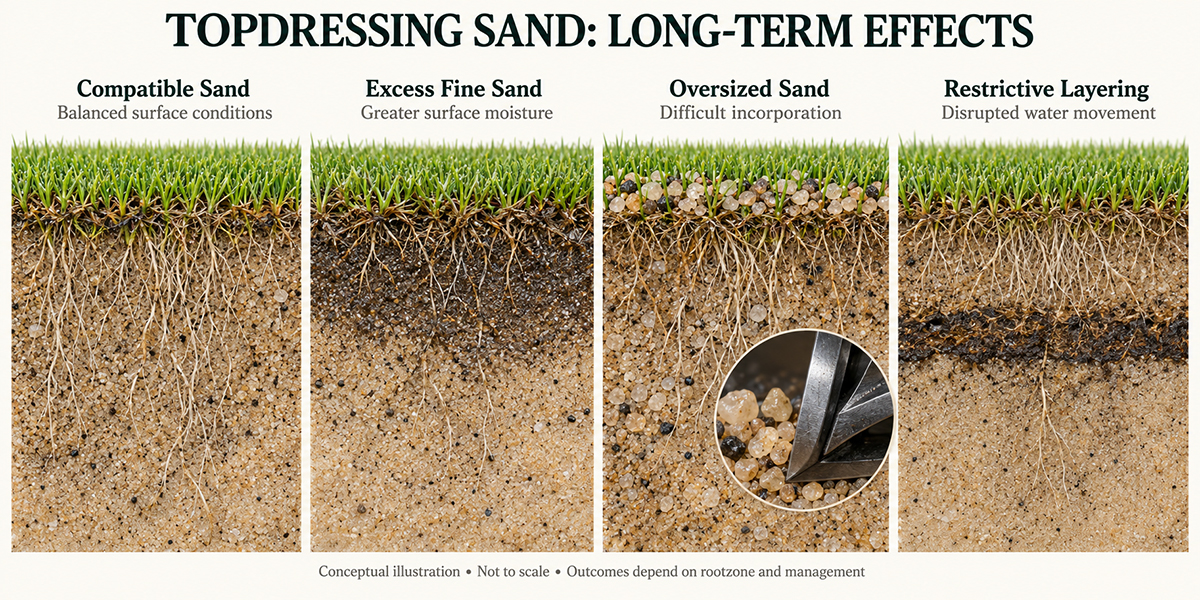
- Sand that’s too fine can make greens gradually wetter and softer, and cultivation offsets only part of that effect.
- Sand that’s too coarse resists incorporation, ends up in mower baskets and can damage reels.
Start With the Existing Green
Sand selection starts with the profile already in place. Older greens often develop a surface layer that differs substantially from the original construction material, so the rootzone you’re matching today may not be the one you built on.
Submit representative rootzone samples and the proposed sands to a qualified physical soil-testing laboratory. Request particle-size analysis and a compatibility assessment, and add hydraulic conductivity, water retention and porosity testing where appropriate. Appearance, feel and a supplier’s description can’t tell you how a sand will interact with the profile below it. Lab data can.
Understand Particle Size
Sand size affects incorporation, surface moisture and stability. These general starting points apply to routine topdressing:
| Sand fraction | Particle diameter | General guideline |
|---|---|---|
| Medium | 0.25 to 0.50 mm | At least 50% |
| Coarse | 0.50 to 1.00 mm | 15 to 40% |
| Fine | 0.15 to 0.25 mm | No more than 25% |
| Very fine | 0.05 to 0.15 mm | No more than 5% |
Ideally, particles larger than 1.0 mm are excluded. These are screening guidelines. They don’t replace a compatibility evaluation for a specific green.
When Sand Is Too Fine, Problems Develop Gradually
Fine sand is appealing because it incorporates easily and causes less immediate disruption. What matters more is how repeated applications change the surface layer.
A seven-year Rutgers study on creeping bentgrass shows the difference. Without hollow-tine cultivation, surface moisture increased as topdressing sand got finer. Medium-fine sand took several years to produce moderately wetter conditions than medium-coarse sand. Sand dominated by fine and very fine particles produced wetter, softer conditions much sooner.
Good incorporation in the first season doesn’t prove a sand will hold up long term. As fine particles accumulate, a green can develop a surface that holds more moisture than intended. That makes the firmness and consistent moisture golfers expect harder to maintain.
Cultivation helps, but it has limits. In the Rutgers trial, hollow-tine cultivation followed by medium-coarse sand backfill offset the extra moisture linked to medium-fine topdressing. It didn’t fully offset the effects of the finest material over the full study. Cultivation is a correction tool, not a substitute for choosing the right sand.
Incompatible Materials Can Create Restrictive Layers
Repeated applications of an incompatible sand can build a distinct layer with different water-retention characteristics from the material below it. That layer can restrict water movement and hold excess moisture near the surface. Laboratory compatibility testing identifies this risk before the material goes down.
Layering also develops when topdressing isn’t frequent enough to dilute accumulating organic matter. Alternating bands of sand and organic matter can restrict water movement, oxygen diffusion and root development. Material selection and application consistency both matter.
Once a restrictive layer exists, better sand on top won’t remove it. USGA guidance notes that additional topdressing can bury the layer deeper and make remediation harder. Corrective cultivation has to match the layer’s depth and severity, and that often means physically removing material.
When Sand Is Too Coarse, Incorporation Becomes a Persistent Challenge
Coarse particles can sit on top of a dense bentgrass canopy and interfere with ball roll and mowing. Research shows coarser topdressing sand is harder to incorporate and more of it gets collected with mower clippings.
That’s a recurring operational cost. Some of the sand you bought and applied leaves the green before it ever becomes part of the surface layer. Large residual particles can also damage mowing equipment.
The answer isn’t simply the finest sand available. Choose a tested material that balances incorporation with long-term physical performance.
A Narrow Particle Range Can Affect Stability
Size distribution matters as much as average particle size. USGA guidance cautions that sand with an excessively narrow grading can produce soft, unstable surfaces. Particle shape plays a role too. Angular sands generally provide more stability than rounded sands. When firmness is a priority, evaluate both.
Coordinate Routine Topdressing and Aeration Sand
A two-sand program can work well. Routine topdressing can use a compatible material with fewer coarse particles to improve incorporation, while aeration holes receive sand suited to the functioning rootzone.
That takes deliberate selection and ongoing monitoring. Success depends on the characteristics of each sand and on the cultivation program, not on labeling one “topdressing sand” and the other “aeration sand.”
Protect the Program With Quality Control
Set a written specification, keep an approved reference sample and test deliveries periodically. Reevaluate the material any time the supplier changes its source or processing.
Monitor the greens too. Track surface moisture, firmness, infiltration, organic matter and visible layering in soil cores. Those observations can flag a developing problem well before it becomes a renovation project.
Frequently Asked Questions
How do I know if a topdressing sand is compatible with my greens?
Send representative rootzone samples and the proposed sand to a qualified physical soil-testing laboratory. Ask for particle-size analysis and a compatibility assessment, plus hydraulic conductivity, water retention and porosity testing where appropriate. Older greens often have a surface layer that no longer matches the original construction material, so test what’s there now.
Is a finer topdressing sand ever the right choice?
Finer sand incorporates easily and disrupts play less, which is why it’s tempting. Repeated use can gradually make the surface wetter and softer, though. A two-sand program is one option. It uses a compatible routine topdressing sand with fewer coarse particles and a sand suited to the rootzone for aeration backfill. Either way, the material should be tested.
Can hollow-tine cultivation offset the effects of fine sand?
Partly. In a seven-year Rutgers study on creeping bentgrass, hollow-tine cultivation with medium-coarse sand backfill offset the added moisture from medium-fine topdressing. It didn’t fully offset the effects of the finest sand over the full study.
What causes layering in a putting green?
There are two main causes. Repeated applications of a sand that’s incompatible with the material below it build a layer with different water-retention characteristics. Topdressing too infrequently to dilute organic matter creates alternating bands of sand and organic matter. Both restrict water movement, and better sand applied on top only buries the layer deeper.
How often should topdressing sand deliveries be tested?
Test deliveries periodically against a written specification and an approved reference sample. Always reevaluate when the supplier changes its source or processing.
Lew’s Final Thoughts
Choose sand for the profile it will build over time. The price per ton is easy to see. The cost of the wrong material shows up later in extra cultivation, disrupted play or corrective work. Testing, compatible materials, consistent applications and steady monitoring protect both bentgrass health and putting quality for the long haul.
Want more turf management insights? Read more Lessons with Lew and talk with your local Tee-2-Green distributor.